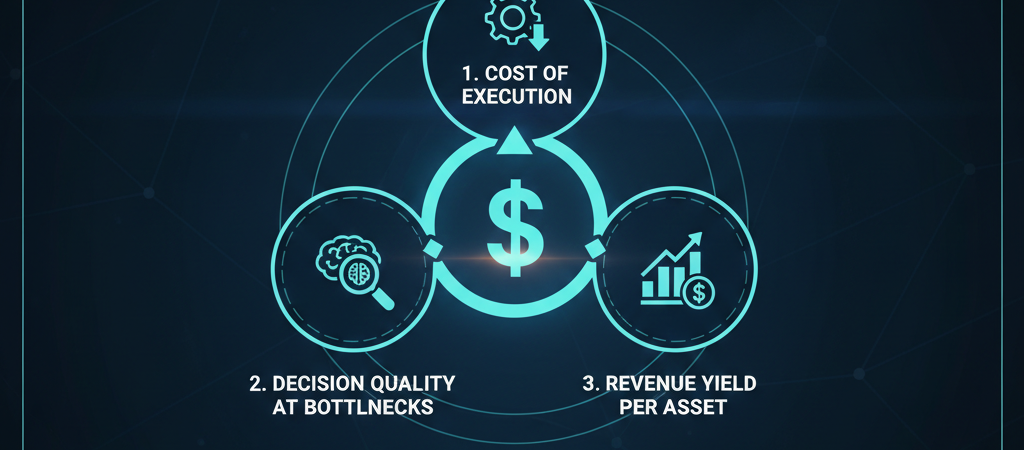
The Only Three Profit Levers AI Can Reliably Improve in SMBs
Why outcome-driven leaders win while others chase tools
The ROI Illusion Leaders Don’t Want to Admit
Most SMB leaders are asking the wrong question about AI.
They ask:
“Which AI tools should we adopt?”
The better—and far rarer—question is:
“Where can AI reliably change our profit equation?”
This distinction matters because most AI investments in small and mid-sized businesses do not fail due to weak technology. They fail because leaders mistake capability for economic leverage.
AI can do many things impressively.
It can write, analyze, summarize, predict, automate.
But profit does not care about capability.
Profit only responds to leverage.
Across industries, business models, and maturity levels, the evidence is surprisingly consistent:
AI can reliably improve only three profit levers in SMBs.
Everything else is speculative, contextual, or prematurely scaled.
Leaders who understand this deploy AI with discipline—and see returns.
Those who don’t accumulate cost, complexity, and false confidence.
Strategic Context: Why Most SMB AI Efforts Underperform
The Real Problem Isn’t Adoption—It’s Misattribution
SMBs are under intense pressure:
- Margin compression
- Rising labor costs
- Higher customer expectations
- Faster competitive imitation
AI appears to offer relief across all fronts simultaneously.
This creates a dangerous cognitive shortcut:
If AI touches everything, it must improve everything.
That assumption is false.
What Has Changed (and What Hasn’t)
What has changed:
- AI capability is cheaper and more accessible
- Vendors market horizontal use cases aggressively
- Leaders feel urgency to “not fall behind”
What has not changed:
- Profit mechanics
- Economic constraints
- Organizational friction
- Human limits of attention, trust, and judgment
AI does not rewrite business fundamentals.
It amplifies them.
This is why AI returns follow power laws:
- A few applications deliver durable gains
- Most create noise or marginal improvement
- Some actively erode value
Core Insight: Profit Only Moves Through Three Levers
From first principles, profit is driven by:
Profit = (Revenue × Margin) − Cost − Risk
In SMBs, AI can reliably influence only three underlying levers—when applied intentionally.
Anything else depends heavily on scale, data maturity, or regulatory context.
Let’s examine each lever through a strategic lens.
Lever 1: Cost of Execution (Operational Throughput)
Why This Is the Most Reliable AI Lever
AI’s strongest, most repeatable impact in SMBs is reducing the cost of routine execution.
This includes:
- Administrative overhead
- Information processing
- Repetitive decision support
- Internal coordination friction
Evidence-based insight:
Automation and augmentation consistently outperform predictive or autonomous AI in smaller organizations due to:
- Lower data requirements
- Faster feedback loops
- Clear accountability
Where AI Actually Pays Off
High-confidence use cases:
- Back-office process automation
- Internal knowledge retrieval
- Customer support tier-1 resolution
- Sales operations support (not selling itself)
Representative example:
An SMB doesn’t gain profit because AI “writes emails.”
It gains profit because one team member can now handle 1.5–2× the workload without burnout.
Trade-Offs and Second-Order Effects
- Over-automation can degrade service quality
- Poorly designed systems shift work instead of removing it
- Hidden coordination costs often offset headline savings
What Not to Do
❌ Automate broken processes
❌ Measure success by task completion alone
❌ Ignore error-handling and human override design
Strategic takeaway:
AI reduces cost most reliably when it removes friction, not judgment.
Lever 2: Decision Quality at Bottlenecks (Not Everywhere)
The Counterintuitive Truth
AI does not improve all decisions equally.
It improves:
- High-frequency
- Pattern-based
- Constrained decisions
It struggles with:
- Strategic ambiguity
- Novel market judgment
- Value-laden trade-offs
In SMBs, profit is disproportionately constrained by a small number of decision bottlenecks, often concentrated in leadership.
Where AI Improves Returns
High-impact decision domains:
- Pricing consistency
- Inventory and demand balancing
- Lead qualification and routing
- Financial forecasting (short-horizon)
Strategic interpretation:
AI doesn’t replace leadership judgment—it compresses variance in repeatable decisions so leaders can focus where human judgment matters most.
Second-Order Effects Leaders Miss
- Over-trusting AI degrades human intuition
- Poorly calibrated models create false certainty
- Decision latency can increase if AI becomes an extra approval layer
What Not to Do
❌ Hand strategic decisions to AI
❌ Treat probabilistic outputs as facts
❌ Remove accountability because “the model said so”
Strategic takeaway:
AI increases profit by improving decision consistency at scale, not by “making smarter leaders.”
Lever 3: Revenue Yield per Existing Asset (Not Growth Itself)
Why AI Rarely Drives Net-New Revenue Reliably in SMBs
AI is often pitched as a growth engine:
- Better marketing
- Smarter sales
- Personalized offers
In practice, net-new revenue gains are:
- Highly contextual
- Difficult to attribute
- Often offset by increased complexity
Where AI does work reliably is improving revenue yield from what the business already has.
Proven Yield Improvements
- Higher conversion on existing demand
- Reduced churn through earlier detection
- More effective cross-sell on known customers
- Better utilization of sales capacity
Key distinction:
AI improves efficiency of monetization, not market creation.
Unintended Consequences
- Over-personalization can feel manipulative
- Optimization can hollow out brand trust
- Short-term lift may mask long-term erosion
What Not to Do
❌ Expect AI to “find customers”
❌ Chase hyper-personalization prematurely
❌ Ignore customer perception and consent
Strategic takeaway:
AI improves revenue when it deepens signal, not when it chases scale.
The Outcome-Driven AI Framework for SMBs
The P³ Model: Profit → Process → Product
Before deploying AI, leaders should sequence decisions deliberately.
Step 1: Start With the Profit Constraint
Ask:
- Where is profit leaking today?
- Is it cost, decision quality, or yield?
- Is the constraint human, structural, or informational?
No clear constraint = no AI ROI.
Step 2: Identify the Process Lever
Evaluate:
- Frequency
- Variability
- Error tolerance
- Feedback speed
Processes that score high on frequency and low on variability are prime candidates.
Step 3: Choose AI Only After Leverage Is Clear
Tool selection comes last, not first.
This avoids:
- Vendor-led strategy
- Tool sprawl
- Capability chasing
Advanced Insight: Why Most SMBs Overestimate AI’s Strategic Upside
Contrarian but evidence-aligned insight:
For SMBs, AI is primarily a margin protection technology, not a growth engine.
Second-order reality:
- AI advantages diffuse quickly
- Differentiation erodes faster than expected
- Operational excellence compounds more reliably than novelty
Leaders who chase AI-led growth often:
- Increase fixed costs
- Add cognitive load
- Dilute focus
Those who use AI to stabilize margins and decision quality gain resilience—and optionality.
Practical Implementation: How to Execute Without Wasting Capital
Metrics That Actually Matter
Track:
- Cost per transaction
- Decision variance reduction
- Revenue per employee
- Error recovery time
Ignore:
- Tool utilization
- Model sophistication
- Vanity productivity metrics
Governance for SMB Reality
You do not need heavy bureaucracy.
You do need:
- Clear ownership
- Explicit boundaries
- Regular review of unintended effects
Governance is lightweight when intent is clear.
Risks, Limits, and Ethical Boundaries
Where This Model Breaks Down
- Highly creative, non-repeatable work
- Early-stage exploration without stable processes
- Regulated domains without compliance readiness
Human and Ethical Considerations
- Job redesign must preserve dignity
- Transparency builds trust internally and externally
- Accountability cannot be delegated to algorithms
AI amplifies leadership values—good or bad.
Conclusion: AI Returns Are a Leadership Discipline
AI does not magically create profit in SMBs.
It reliably improves returns only when leaders:
- Focus on three levers, not everything
- Design for outcomes, not tools
- Apply discipline before scale
The organizations that win with AI are not the most experimental.
They are the most intentional.
And in the end, intentionality—not technology—is what compounds.